

Life is often described through what we can see: organisms grow, move, reproduce, adapt, and interact with their surroundings. But beneath every one of these processes is a complex network of chemical reactions. From the energy released by food to the information stored in DNA, living systems depend on chemistry at every level.
Understanding biochemistry helps explain everything from how enzymes speed up reactions to how proteins are built, how cells produce energy, and how genetic information is stored and expressed.
What Is the Biochemistry of Life?
Biochemistry is the study of the chemical substances and processes found in living organisms. Instead of looking only at an organism as a complete biological system, biochemistry examines what happens at the molecular level.
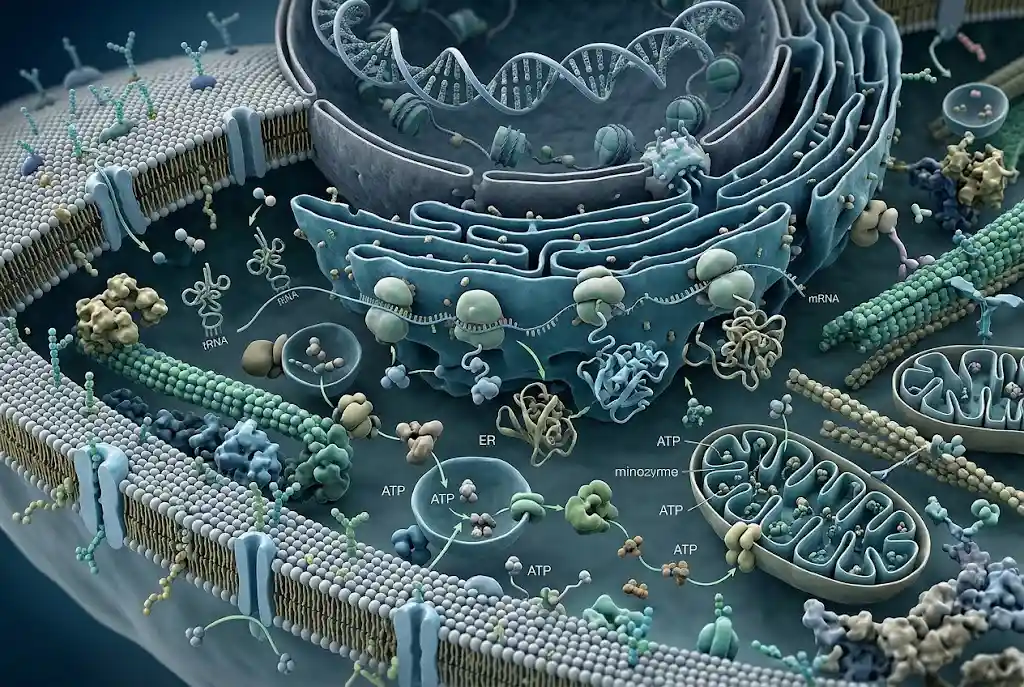
Inside a cell, thousands of chemical reactions occur continuously. Molecules are broken down, rebuilt, transported, modified, and used as signals. These reactions are organized into interconnected pathways that allow cells to obtain energy, build cellular structures, remove waste, communicate, and respond to changes in their environment.
The chemistry of life is therefore not a collection of isolated reactions. It is a coordinated system in which different molecules and pathways depend on one another.
The Major Molecules That Make Life Possible
Although living organisms contain an enormous variety of chemical compounds, four major classes of biological molecules are especially important: carbohydrates, lipids, proteins, and nucleic acids.
Carbohydrates
Carbohydrates include simple sugars such as glucose as well as larger molecules made from linked sugar units. They can provide energy for cellular processes and can also contribute to structural functions.
Glucose is particularly important in cellular metabolism because cells can process it through a series of reactions that help capture usable chemical energy. Carbohydrates can also be stored or incorporated into larger biological structures.
This makes carbohydrates much more than a dietary energy source. Their molecular structures allow them to participate in several essential biological functions.
Lipids
Lipids include fats, oils, phospholipids, and steroids. One of their most important roles is forming biological membranes.
Phospholipids have both water-attracting and water-repelling regions. In the watery environment of a cell, these properties encourage phospholipids to organize into membrane structures. Cell membranes provide boundaries around cells and organelles while controlling the movement of many substances.
Lipids can also act as energy-storage molecules and participate in biological signaling. Some lipid-derived molecules function as hormones or signaling compounds, showing how chemical structure can influence biological activity.
Proteins
Proteins are among the most versatile molecules in living organisms. They are constructed from amino acids, but differences in amino-acid sequence allow proteins to fold into different three-dimensional structures and perform different functions.
Some proteins provide structural support. Others transport molecules, receive signals, defend against biological threats, or regulate cellular processes.
Many enzymes are also proteins. Their ability to interact with specific molecules allows them to accelerate chemical reactions that would otherwise occur too slowly to support normal cellular activity.
Nucleic Acids
DNA and RNA are nucleic acids that play central roles in biological information.
DNA stores genetic information in the sequence of its nucleotides. Cells can copy this information and use it as part of the processes that determine which proteins and functional RNA molecules are produced.
RNA performs several important roles in cells. Some RNA molecules help carry genetic instructions, while others participate directly in protein production, gene regulation, and RNA processing.
Why Water Is Essential to Biochemistry
Water is one of the most important chemical substances in living systems. It does not simply fill the spaces inside cells; its chemical properties influence how biological molecules interact and organize themselves.
Because water is a polar molecule, it interacts effectively with many ions and polar compounds. At the same time, nonpolar regions tend to avoid contact with water. These interactions contribute to the structure of cell membranes and influence how proteins fold into functional shapes.
Water also provides the environment in which many biochemical reactions occur. Without its distinctive chemical properties, the organization and chemistry of living cells would be fundamentally different.
Enzymes: The Catalysts of Life
Many biological reactions need help to occur quickly enough under the conditions found inside cells. Enzymes provide that assistance.
An enzyme is a biological catalyst that increases the rate of a chemical reaction without being consumed by the reaction itself. Enzymes generally interact with particular molecules, called substrates, and help transform them into products.
The specificity of enzymes is especially important. Cells contain numerous metabolic pathways, and enzymes help direct particular reactions instead of allowing cellular chemistry to proceed randomly.
Enzyme activity can also be regulated. Cells can increase or decrease the activity of enzymes depending on their needs, allowing metabolism to respond to changes in nutrients, energy requirements, and environmental conditions.
Metabolism and the Chemistry of Energy
Metabolism is the collection of chemical reactions through which cells acquire, transform, store, and use matter and energy.
Some metabolic pathways break larger molecules into smaller molecules. These reactions can release energy that cells capture in chemically useful forms. Other pathways use energy to build larger molecules from smaller components.
These two broad directions are often described as catabolism and anabolism. Catabolic reactions generally break molecules down, while anabolic reactions build molecules and cellular structures.
The two processes are closely connected. Energy and molecular building blocks produced by one pathway can become resources for another.
ATP and Cellular Energy
One molecule that plays a central role in cellular energy transfer is adenosine triphosphate, or ATP.
Cells use ATP to transfer chemical energy to processes that require energy. These processes can include the synthesis of molecules, active transport across membranes, movement, and other forms of cellular work.
ATP should not be thought of as a long-term energy-storage molecule in the same way that fat can store energy. Instead, it functions as an important intermediary that helps transfer energy between energy-releasing and energy-consuming reactions.
How Food Becomes Part of Cellular Chemistry
Food provides more than calories. It supplies molecules and nutrients that can become part of the biochemical pathways operating inside cells.
Carbohydrates can be broken down into smaller molecules that enter energy-producing pathways. Proteins can be digested into amino acids that can be used to build new proteins and other compounds. Lipids can provide fatty acids and other molecules that can be used for energy, membranes, and signaling.
Vitamins and minerals also contribute to normal biochemical processes. Some vitamins or their derivatives are required for enzymes to function properly, while minerals can serve structural, regulatory, or catalytic roles.
DNA, RNA, and the Flow of Biological Information
One of the most important relationships in biochemistry is the connection between genetic information and cellular function.
DNA contains sequences that provide instructions for biological processes. Through cellular mechanisms involving transcription and translation, information encoded in DNA can contribute to the production of proteins.
Proteins then perform many of the activities that keep cells functioning. They can act as enzymes, structural components, transporters, receptors, and regulators.
This creates a powerful connection between genetic information and biochemistry: information stored in nucleic acids ultimately influences the molecules that carry out many cellular functions.
How Cells Control Biochemical Reactions
Living cells cannot allow every chemical reaction to happen at maximum speed. If that occurred, cellular resources would quickly become unbalanced.
Instead, cells regulate biochemical pathways through mechanisms such as enzyme regulation, changes in substrate availability, chemical signals, and feedback mechanisms.
In a feedback pathway, for example, the final product of a series of reactions can influence an earlier step in the pathway. This provides a way for cells to prevent unnecessary production and conserve resources.
Biochemistry and Cellular Communication
Cells also rely on chemical signals to communicate with one another and respond to their surroundings.
Signaling molecules can bind to receptors on or inside cells. The interaction can trigger a series of molecular events that changes cellular behavior.
Depending on the signal, a cell may alter gene activity, modify enzyme function, transport substances across its membrane, change its metabolism, or communicate with neighboring cells.
These signaling networks demonstrate another important principle of biochemistry: a small molecular interaction can produce a much larger biological response.
Why Biochemistry Matters in Modern Science
Biochemistry provides a foundation for many areas of modern science and medicine. Researchers use biochemical knowledge to study how cells function normally and how molecular processes change during disease.
Understanding proteins, enzymes, DNA, RNA, metabolism, and cellular signaling can help researchers investigate biological mechanisms and identify potential targets for diagnostics and therapies.
Biochemistry also overlaps with molecular biology, genetics, nutrition, pharmacology, biotechnology, and other scientific fields. For readers interested in the wider relationship between scientific research and technological development, IdeaBloomPlus also covers broader developments in science and technology research and innovation.
The Connection Between Chemistry and Life
One of the most fascinating aspects of biochemistry is that living systems emerge from interactions between ordinary chemical principles.
Molecules can bond together, change shape, transfer energy, respond to electrical charges, and interact with their surroundings. When these chemical behaviors are organized into complex networks, they create the processes associated with living systems.
A cell therefore should not be viewed simply as a collection of molecules. It is a highly organized chemical system in which molecules constantly interact and respond to one another.
Frequently Asked Questions About the Biochemistry of Life
What is the biochemistry of life?
The biochemistry of life is the study of the chemical molecules and reactions that allow living organisms and their cells to function. It includes areas such as proteins, enzymes, DNA, RNA, metabolism, cellular energy, and molecular signaling.
What are the four major biomolecules?
The four major classes of biological macromolecules are carbohydrates, lipids, proteins, and nucleic acids. Each has different chemical structures and biological functions.
Why are enzymes important in life?
Enzymes accelerate specific chemical reactions and help cells control biochemical pathways. Without enzyme activity, many essential reactions would occur too slowly under normal cellular conditions.
What role does ATP play in cells?
ATP acts as an important energy-transfer molecule. Cells use ATP to help power processes such as molecular synthesis, active transport, movement, and other forms of cellular work.
How are DNA and proteins connected?
DNA stores genetic information that can be used through cellular processes to produce proteins. Proteins then perform many structural, catalytic, transport, signaling, and regulatory functions inside living organisms.
Is biochemistry only about human biology?
No. Biochemistry applies to humans, animals, plants, microorganisms, and other living systems. Many fundamental biochemical processes are shared across different forms of life, although their specific pathways and adaptations can differ.
Final Thoughts
The biochemistry of life reveals how chemistry becomes organized into the complex processes required for living systems. Carbohydrates help provide and store energy, lipids contribute to membranes and signaling, proteins perform an enormous variety of functions, and nucleic acids store and help express biological information.
Enzymes coordinate chemical reactions, metabolism manages matter and energy, ATP helps transfer usable energy, and molecular signals allow cells to respond to their surroundings.
When these processes are viewed together, life becomes a remarkable example of organized chemistry. Studying biochemistry allows us to move beneath the visible features of living organisms and understand the molecular interactions that make those features possible.