

Indoor cats live longer, safer lives than their outdoor-roaming counterparts — but a life inside four walls can turn boring without indoor cat enrichment. A bored cat becomes restless: scratching the sofa, racing around at 3 a.m., or over-grooming from frustration. The good news is that keeping your cat mentally and physically engaged does not require expensive gadgets. From play sessions that mimic the hunt to puzzle feeders, window perches, and simple training games, these ten practical indoor cat enrichment ideas keep your cat happy, active, and healthy.
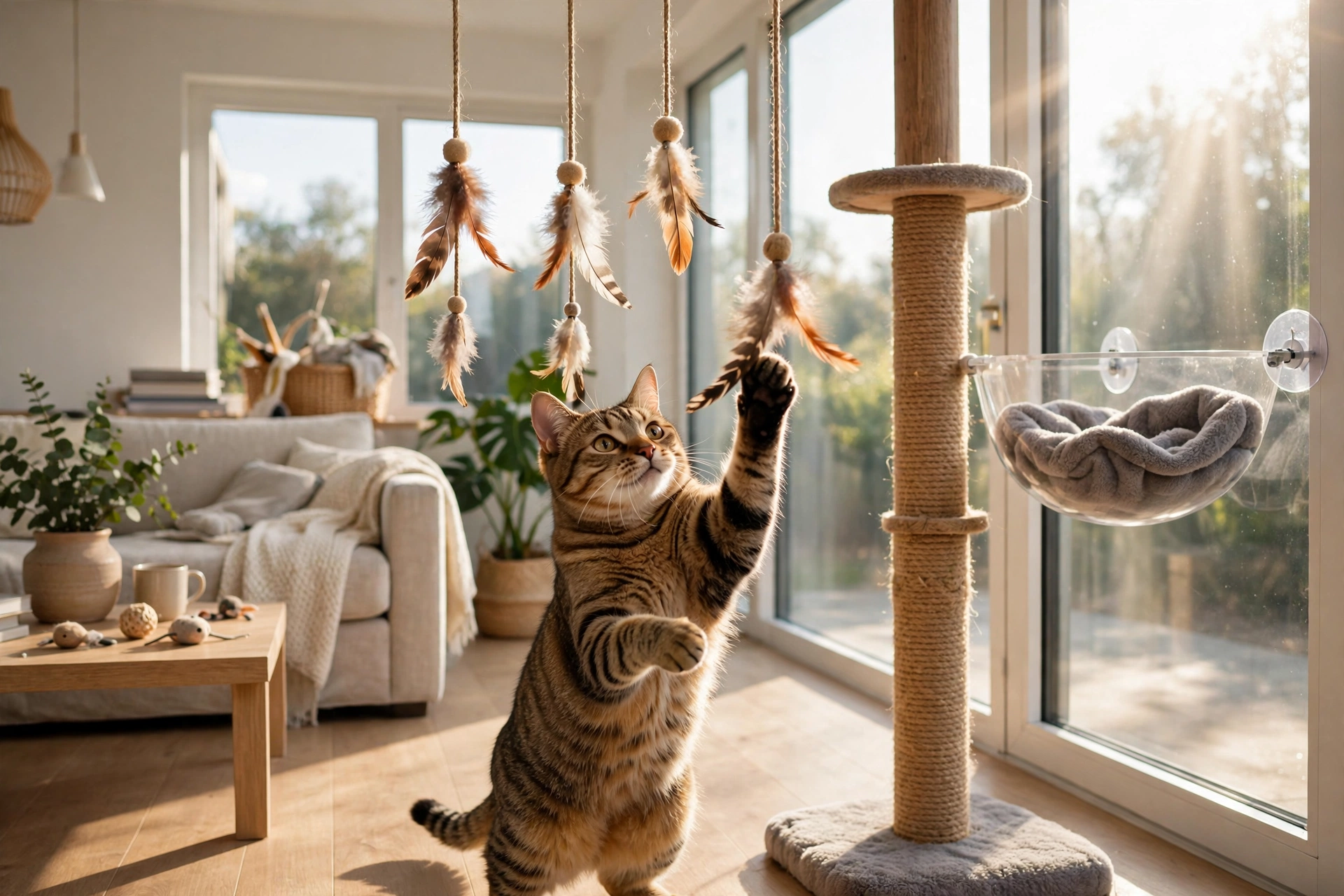
1. Schedule Interactive Play That Mimics the Hunt
Play is the single most effective enrichment habit you can build. A wand toy with feathers or a fuzzy lure lets you imitate prey: drag it along the ground, pause, dart it behind furniture, and let your cat stalk, chase, pounce, and “kill” it. Aim for two short, intense sessions of ten to fifteen minutes a day, ending with a small meal or treat so the hunt-catch-kill cycle feels complete. If your cat loses interest, move the toy slower and closer to the ground — prey runs and hides, it does not circle overhead.
2. Put Scratching Posts Where Cats Actually Scratch
Scratching is natural, not naughty: it stretches muscles, sheds old claw sheaths, and lets cats mark territory. Place tall, sturdy posts near the furniture your cat already targets and beside favorite sleeping spots, since cats love a stretch right after waking up. Offer different textures — sisal rope, corrugated cardboard, carpet — and make sure the post is tall enough for a full-body stretch and solid enough not to wobble. Reward your cat with a treat the first few times they use it to build the habit.
3. Set Up a Window Perch for Bird-Watching
Cats are natural observers, and a comfortable window perch turns an ordinary window into hours of free entertainment. Watching birds, squirrels, and passing people engages your cat’s visual hunting instincts with no effort from you. Choose a window with good daylight, add a soft cushion so it doubles as a napping spot, and consider hanging a bird feeder outside — this is one of the simplest enrichment upgrades there is. If your cat chirps at birds, that is a normal predatory response, not a sign of stress.
4. Give Your Cat Vertical Space With a Cat Tree
Cats feel safest when they can survey their territory from above. A multi-level cat tree offers climbing routes, high resting platforms, and enclosed hideaways in one piece of furniture — especially valuable in smaller apartments, where it effectively doubles your cat’s living space without using floor area. Place it near a window or a well-used room, since cats like being near their people even when perching alone. If a full tree is too big or costly, wall-mounted shelves or a cleared bookshelf top work just as well.
5. Make Mealtime a Game With Puzzle Feeders
In the wild, cats work for every meal, but indoor cats usually get free food on demand. Puzzle feeders and food-dispensing toys reintroduce that effort, slowing down fast eaters and keeping your cat’s brain busy. Start simply by scattering dry kibble or hiding portions in different rooms so your cat has to “forage.” Then graduate to rolling treat balls, snuffle mats, or puzzle boards, increasing difficulty gradually. Keep puzzle feeding to a reasonable share of the daily diet so meals stay nutritionally balanced.
6. Rotate Toys to Beat Boredom
Cats lose interest in toys that sit out all the time — a toy that is always available becomes part of the furniture. The fix is rotation: keep a basket of toys and swap them every few days. Toys that disappeared a week ago feel brand new when they reappear, and this trick costs nothing. Mix textures and motions — crinkly balls, soft mice, springs — and hide a few around the house for your cat to discover. For a young cat, also read How to Litter Train a Kitten: A Step-by-Step Beginner’s Guide — it covers the other essential early routines.
7. Offer Cardboard Boxes and Paper Bags
Ask any cat owner: the most expensive toy in the house usually loses to the box it came in. Boxes and paper bags give cats the enclosed hiding spots they crave, satisfying the instinct to watch the world from a sheltered position. Cut a couple of entry and exit holes in a box to create a multi-room fort, and toss a crinkly toy or a sprinkle of catnip inside for extra appeal. Remove plastic handles from paper bags before play, and never leave your cat unsupervised with bags they could get tangled in.
8. Add Cat-Safe Plants and Indoor Grass
Bringing the outdoors inside is powerful enrichment. Many cats love nibbling on grass, and a tray of fresh cat grass — wheat, oat, or barley grass — gives them a safe, healthy outlet; growing your own from seed takes about a week. If you like houseplants, choose cat-safe varieties such as spider plants, Boston ferns, or catnip, and move toxic plants like lilies, pothos, and sago palms completely out of reach, since true lilies can be fatal to cats. A small herb garden on a sunny windowsill adds interesting scents and textures too.
9. Try Simple Clicker Training
Clicker training is not just for dogs. Cats learn quickly through positive reinforcement, and short sessions are outstanding mental enrichment. Start by “charging” the clicker: click, then immediately offer a treat, repeating until your cat perks up at the sound. Then teach a simple behavior like touching your finger with their nose — click and treat every success. Keep sessions to three to five minutes and always end on a win. Training builds confidence in shy cats and gives older or less playful cats a low-impact way to engage their brains.
10. Build a Catio or Try Supervised Harness Time
A catio — an enclosed outdoor patio — offers the sights and smells of the outdoors with none of the risks. If a catio is not possible, a well-fitted harness and leash gives a confident cat safe outdoor experiences: let your cat wear the harness indoors first, then keep outings short. If you also share your home with a dog, enrichment should never compromise safety — Introducing a New Cat to Your Dog: A Stress-Free Step-by-Step Guide shows how to keep both animals calm around each other.
Signs Your Cat Needs More Indoor Cat Enrichment
Nighttime “zoomies” — frantic sprints around the house at 2 or 3 a.m. — usually mean unused hunting energy with nowhere to go. Destructive scratching on furniture, despite having a post nearby, often signals boredom rather than defiance, and over-grooming that leads to bald patches can be a stress response to a monotonous environment. Constant meowing for attention, rough play, or weight gain from boredom eating are other clues. If these behaviors appear suddenly, see your vet first — but when health checks come back clean, a richer enrichment routine is usually the answer.
FAQ: Indoor Cat Enrichment Questions
How much playtime does an indoor cat need each day?
Most adult cats do well with two interactive sessions of ten to fifteen minutes each. The right amount is whatever leaves your cat calm and content rather than restless in the evening.
Is a single indoor cat lonely, or is enrichment enough?
Many cats are perfectly happy as solo pets when their days include play, foraging, and human interaction. A second cat helps in some cases, but personality matters more than company — never assume a quiet cat automatically wants a roommate.
Are laser pointers good enrichment?
They can be fun as part of play, but never end a session on the laser alone. Always finish with a toss toy or a treat so the hunt cycle feels complete.
Conclusion
Indoor cat enrichment does not have to be complicated or expensive. Daily interactive play, places to climb and scratch, puzzles at mealtime, a window to watch the world, and rotated toys will transform your cat’s quality of life. Start with the ideas that fit your home and your cat’s personality, stay consistent, and you will see the difference in calmer nights, healthier weight, and a cat that is genuinely content to live indoors.