

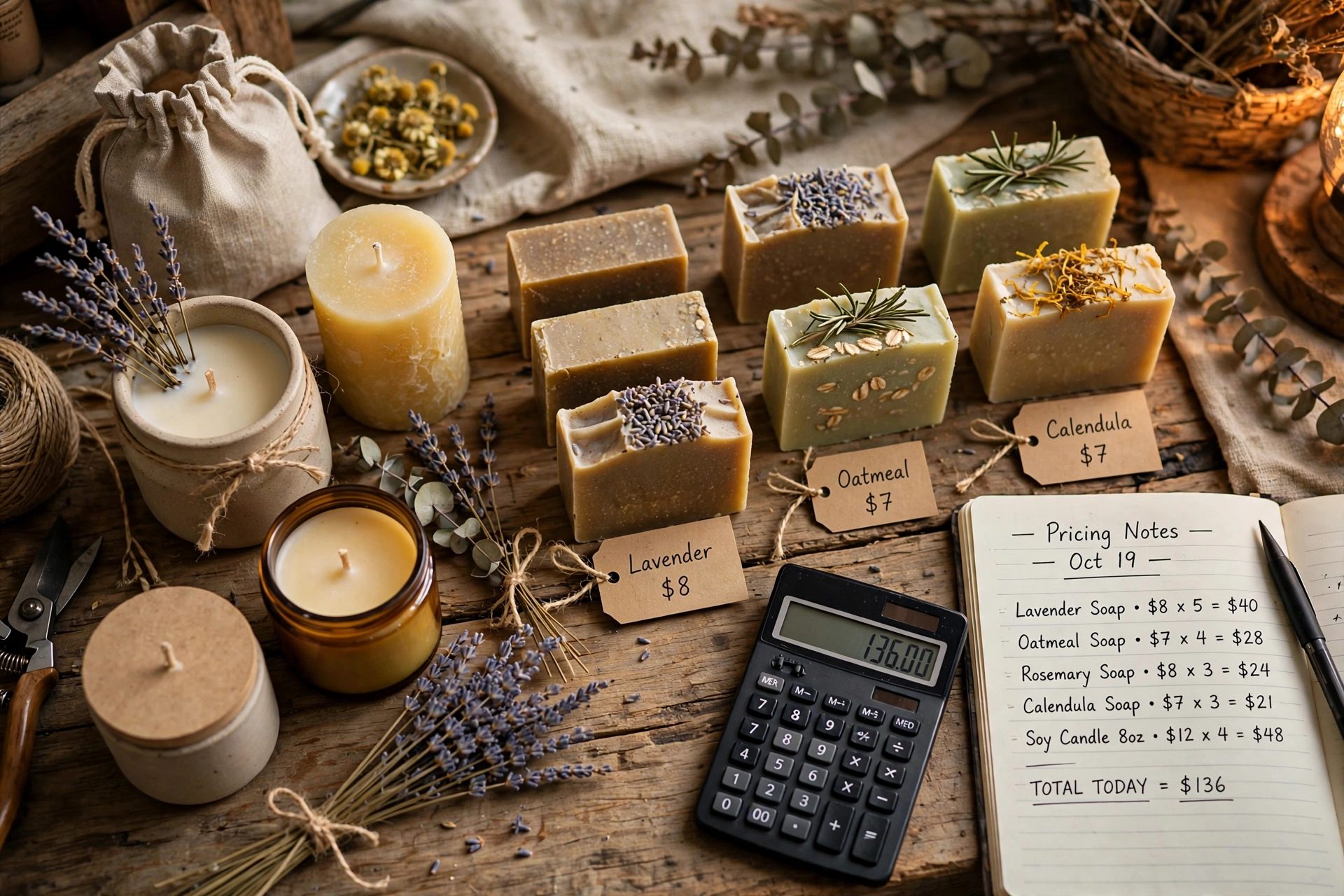
If you’ve ever sold a handmade product and felt uneasy about the price tag, you’re not alone. Most makers price by guessing, copying someone else, or picking “a number that feels fair” — and underpricing is practically an epidemic in the handmade world. The good news? Pricing doesn’t have to be a guessing game. There’s a simple, repeatable formula that makes sure you actually get paid for what you make, and this article walks you through it step by step, with a worked example you can apply to your own products today.
Why Most Makers Underprice Their Work
The underpricing problem usually starts before the first sale. Many handmade sellers begin as hobbyists making gifts for friends, and the habit of pricing “nicely” carries straight into business. There’s also a deep-seated fear that charging more will scare buyers away — so makers shave prices down to feel competitive, often racing to the bottom against sellers who may not be calculating their true costs at all.
Another big culprit is invisible costs. Materials feel concrete, but the two hours spent hand-finishing a piece, the electricity, the packaging, the listing fees, the photographing and promoting — these are real costs, and ignoring them doesn’t make them vanish. They just come out of your pocket instead of your customer’s.
Finally, there’s the emotional discount. When you’ve made something with your own hands, charging a professional price can feel arrogant. It’s not. If you’re serious about turning your craft into income — or building something bigger like starting a home-based business — treating your labour as a genuine business expense is the most important mindset shift you can make.
The Simple Pricing Formula
Here is the formula that works for nearly every handmade product:
Price = (Materials + Labour + Overhead) × 2 — or × 2.5
Let’s break down each piece:
- Materials: Every raw material that goes into the product, including thread, glue, clasps, tags, and packaging — not just the headline ingredients.
- Labour: Your hourly rate multiplied by the hours it takes to make one unit, including finishing and packaging.
- Overhead: Your share of business expenses per item — electricity, tool wear, listing fees, payment processing, marketing, shipping supplies.
- Multiplier (× 2 or × 2.5): This doubles your cost base to build in a profit margin, and leaves room for wholesale discounts later.
A Worked Example
Say you make scented soy candles. One candle costs you:
- Soy wax, fragrance oil, wick, and jar: $4.50 (materials)
- Your hourly rate of $18, and each candle takes 20 minutes to make and pack: $6.00 (labour)
- Electricity, melting pot wear, listing fees, packaging materials share: $1.50 (overhead)
Total cost per candle: $4.50 + $6.00 + $1.50 = $12.00. Multiply by 2 and your retail price is $24.00; by 2.5 it’s $30.00 — healthier if you sell at craft fairs or online, where fees and promotions eat into margins.
This isn’t an arbitrary markup. The multiplier covers taxes, the occasional ruined batch or broken shipment, reinvestment in better tools, and leaves you an actual profit — not just reimbursement. Without it, you’re running a self-funded hobby, not a business.
How to Calculate Your Hourly Rate
The labour line of the formula is where most makers get stuck, because it forces an uncomfortable question: what is an hour of your time actually worth? Here’s a straightforward way to find it.
Start with the annual income you’d like to earn from your craft — an honest number that would genuinely sustain you. Divide that by the billable hours you can realistically work in a year. If you want to earn $30,000 and can devote 1,000 hours a year to production (the rest goes to marketing, admin, and learning), your hourly rate is $30.
If that number feels high, resist the urge to slash it to match minimum wage. A few reality checks:
- Compare with skilled trades: A plumber or electrician charges $60–$100+ an hour. Your specialised craft skill is comparable — price accordingly.
- Include non-making time: Photographing products, answering customer messages, bookkeeping, and social media are all labour. If they’re not captured in your hourly rate, they don’t exist in your pricing.
- Revisit it yearly: As your speed improves and your reputation grows, your rate should climb. Many established makers raise their hourly rate 5–10% a year.
Track your actual making time with a timer for a week — phone stopwatch is fine. Most makers are stunned to discover a “30-minute project” really takes 75 minutes once cutting, setup, cleanup, and packaging are counted.
Wholesale vs Retail Pricing
Sooner or later, a shop owner will ask about wholesale. Shops typically expect to buy at 50% of your retail price — the standard “keystone” markup. This is exactly why the ×2 (or ×2.5) multiplier matters: at $24 retail, wholesale is $12, and your true costs are $12 — you’d break even, which is not good enough.
This is the strongest argument for ×2.5. At $30 retail, wholesale is $15 against $12 costs — a modest $3 per unit, but wholesale compensates with volume and zero marketing effort. Alternatively, keep ×2 but set a minimum wholesale order quantity (say, 24 units) so volume offsets the thinner margin.
Rules to live by:
- Never discount retail to win wholesale: Wholesale is exactly 50% of retail, with minimum order quantities. No exceptions for friends of friends.
- Keep one public retail price everywhere: Your website, your craft fair table, and your stockists should all reference the same retail price. Undercutting your stockists destroys those relationships overnight.
Psychological Pricing Tips
Once your formula gives you a number, a few small tweaks can make it perform better with real buyers:
- Charm pricing works: $24 feels meaningfully cheaper than $25 to most shoppers. Use prices ending in 7 or 9 for direct-to-consumer sales.
- Avoid the bargain-bin look: Handmade is a premium category. A price like $19.99 can cheapen a hand-thrown ceramic mug; $22 or $24 reads as crafted and confident.
- Bundle instead of discounting: Rather than cutting a price your formula says is correct, offer “3 for $65” sets. You protect your per-unit margin while giving buyers a reason to spend more.
- Show the work: Buyers pay more when they understand the labour. A short line in your listing — “each piece takes 3 hours to hand-finish” — justifies your price far better than any apology for it.
Common Pricing Mistakes to Avoid
Watch out for these traps, because nearly every maker falls into at least one:
- Copying competitors’ prices: You don’t know their costs, their suppliers, or whether they’re even profitable. Their price is data, not a decision.
- Forgetting fees: Marketplace fees, payment processing (typically 3–6% combined), and shipping materials routinely eat 10–15% of revenue. If your formula doesn’t account for them, add them to overhead.
- Charging the same for custom work: Personalisation, rush orders, and custom designs cost extra time and carry extra risk. Add a 20–30% custom surcharge as standard.
- Apologising for your prices: Defensive language in listings (“I know it’s a bit expensive but…”) signals to buyers that even you don’t believe the price. State it plainly and move on.
When to Raise Your Prices
Raising prices feels risky, but the signals are clear. If you’re consistently selling out, the market is telling you you’re too cheap. If your waiting list stretches past a month, raise prices before you burn out trying to serve it. If suppliers raise their prices, pass it on promptly — absorbing cost increases silently is how margins die.
The right way to raise prices: do it in one confident step, give existing customers a heads-up (“prices update on the 1st”), and never apologise — announce it as a natural part of a growing business. Most makers discover the feared backlash never materialises; a few price-sensitive buyers leave, replaced by customers who value the work properly. If you’re exploring handmade selling alongside other income streams, it pairs well with broader side hustle ideas for beginners — but only the ones priced for profit will actually last.
Conclusion
Pricing handmade products comes down to one discipline: know your true costs, pay yourself a real hourly rate, build in overhead and profit with a multiplier — and then stop second-guessing the number. Run the formula on your best-selling product this week and close the gap. Your craft deserves to sustain you, not just occupy you.