
# US Tourist Visa Interview Tips for First-Time Applicants
– **Slug:** us-tourist-visa-interview-tips-first-time-applicants
– **Category:** Travel (27)
– **Focus keyword:** us tourist visa interview tips for first time applicants
– **Scheduled PKT:** 15:00 (date_gmt 2026-10-21T10:00:00)
– **Post ID:** (assigned on publish)
– **URL:** (assigned on publish)
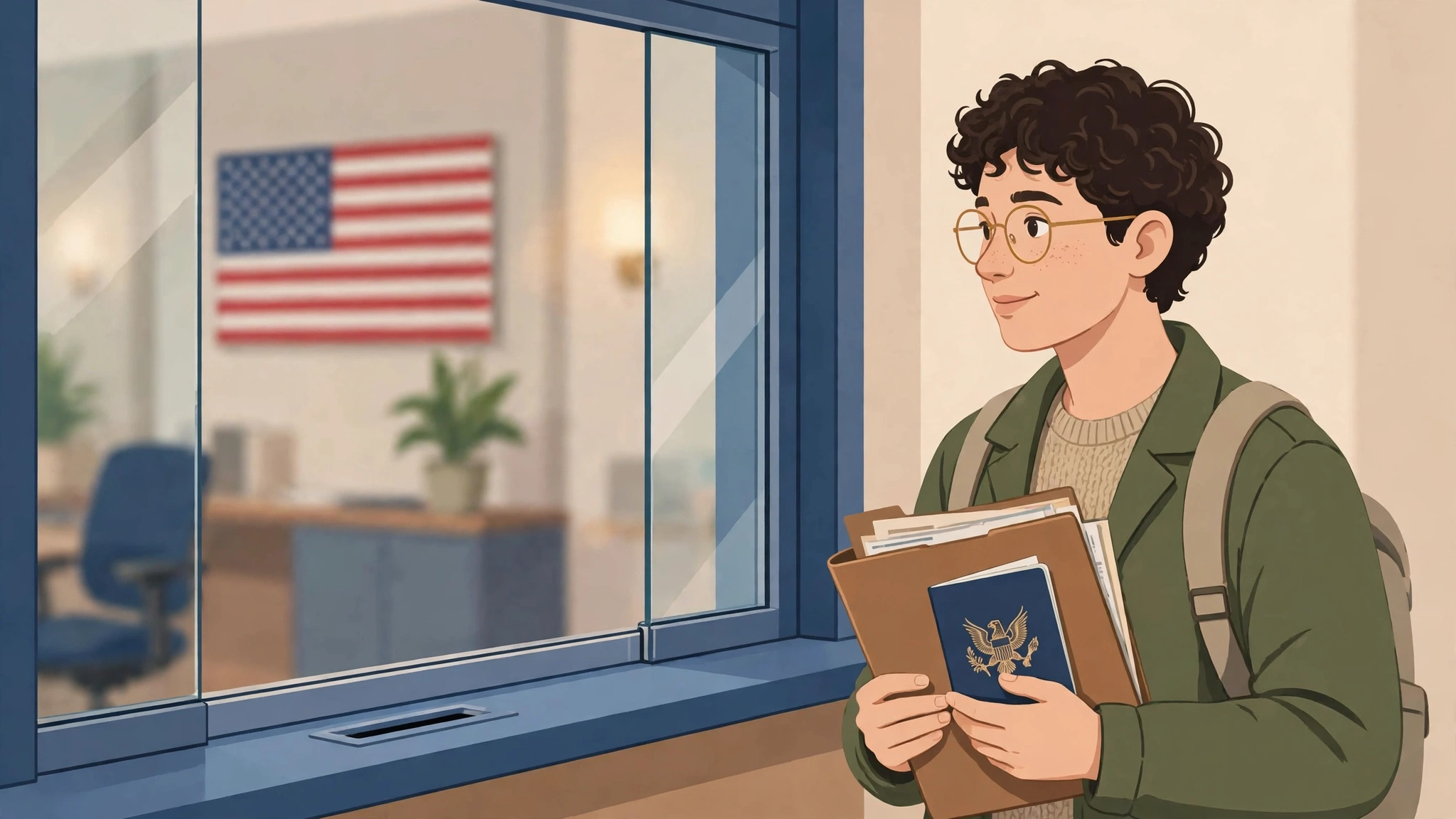
You have the itinerary sketched out — maybe a cousin’s wedding in Houston, a week in New York, or that road trip down the California coast you have been saving for. Then comes the part every first-time applicant dreads: the visa interview. A consular officer, a window, and about three minutes to decide whether your trip happens. These US tourist visa interview tips are built for first-time applicants who want to walk in prepared, stay calm, and give themselves the best possible chance.
What the Officer Is Really Deciding
The interview is short, but it is not random. Under US immigration law, every B-1/B-2 visitor visa applicant is presumed to be an intending immigrant until they show otherwise. That single presumption is the whole game: the officer must be convinced, in a few minutes, that you are a genuine temporary visitor who will return home.
Practically, that means two things. First, you must show strong ties to your home country — a stable job, a business, property, enrolled studies, or family obligations that anchor you there. Second, you must show that your trip has a clear, believable purpose that matches your finances and documents. Everything you say, and every paper you bring, feeds one of these two questions. Understanding that before you walk in changes how you prepare.
Get Your Documents in Order First
You cannot talk your way past missing paperwork. Complete the DS-160 online application form first (on the US State Department’s Consular Electronic Application Center), save your application ID — the site is known to time out — and print the confirmation page with its barcode. Then pay the non-refundable visa application fee, currently $185 for a B-1/B-2, before you can schedule your interview. Fees can change, and additional charges have been reported for 2026, so confirm the current total on the State Department’s site before paying.
Bring these to your interview:
- Passport valid for at least six months beyond your planned stay (this varies by nationality — check the rule for your country).
- DS-160 confirmation page with the barcode.
- Interview appointment confirmation and the visa fee receipt.
- One recent passport-style photograph (2×2 inches) meeting US visa standards, as a backup to your DS-160 upload.
- Proof of ties: an employment letter stating your position, salary, and approved leave; business registration if self-employed; property documents; or proof of enrollment.
- Financial proof: recent bank statements showing stable income and enough balance to fund the trip — the last three to six months is the usual range.
- Trip plan: a simple day-by-day outline, hotel names, and any invitation letter if you are visiting family.
Interview wait times vary enormously by city and season — from a few weeks to several months — so schedule early. If you are also mapping out flights, packing, and budgets, How to Plan Your First International Trip: A Complete Step-by-Step Guide for 2026 covers the planning side that runs alongside the visa process.
Common Interview Questions (and How to Answer Them)
Most interviews last two to four minutes and revolve around a handful of predictable questions. The officer is not looking for perfect answers — they are listening for consistency with your DS-160 and documents.
- “Why are you going to the US?” Give a specific purpose: “tourism — ten days in New York and Washington, staying with my cousin,” not “to visit.” Vague answers invite follow-up questions.
- “What do you do for a living?” State your job, employer, and how long you have been there. This is where your ties start to show.
- “Who is paying for the trip?” Be exact. If it is you, say so and point to your bank statements. If a relative is sponsoring you, name them and bring their support letter and financial proof.
- “Have you traveled abroad before?” Answer truthfully. Previous travel history helps, but first-time travelers get visas every day — it is not a requirement.
- “How long will you stay?” Match your answer to your itinerary. A three-week request from someone with ten days of approved leave raises eyebrows.
Answer in your own words. Officers interview hundreds of people a week and can spot rehearsed scripts instantly — natural, brief answers beat polished speeches.
8 Practical Tips for Interview Day
- Arrive early. Plan to reach the embassy 30 minutes before your slot. Security screening takes time, and phones and large bags are usually not allowed inside.
- Dress like you take the meeting seriously. Neat, business-casual clothing sends the right signal — it needs to be respectful, not formal.
- Bring originals, organized. Keep documents in a folder in the order listed above so you can hand one over without fumbling.
- Keep answers short and on-point. One to two sentences per question, answering only what was asked. Rambling explanations make officers wonder what you are hiding, and silence between answers is perfectly fine.
- Speak for yourself. Do not look to family members in the waiting area to answer for you, and do not send a relative to the window in your place.
- Stay consistent. Every answer should match your DS-160 and your documents. Contradictions — even small ones — are the fastest way to be refused.
- Never lie or exaggerate. Misrepresentation to a consular officer has serious, long-term consequences for future applications. If you do not know something, say so.
- Ask for your language if you need it. Interviews can be conducted in your local language at most posts. Struggling in broken English when help is available only hurts your clarity.
4 Mistakes That Hurt First-Time Applicants
1. Booking non-refundable travel before approval. Do not pay for flights or hotels you cannot cancel. Officers do not expect you to have tickets — a planned itinerary is enough.
2. Showing weak or unverifiable ties. A brand-new job, no fixed address, and no financial history is a hard sell. Lean on what you do have: enrollment, family, a concrete return plan.
3. Submitting inconsistent paperwork. A DS-160 that says one employer and a letter from another, or dates that do not line up, will be caught. Review everything the night before.
4. Letting an agent fill your DS-160 without reviewing it. You are responsible for every line on that form. Read it yourself before the interview — officers will ask about details on it.
What Happens After the Interview
In most cases you will know the outcome before you leave the window. If approved, your passport is kept and returned with the visa — usually within a week, though timelines vary by post. Sometimes the officer needs more time or documents and places your case in administrative processing; this is not a refusal, but it can add weeks. If you are refused, the officer will give you the reason, typically under section 214(b) — failure to demonstrate nonimmigrant intent. A refusal is not a lifetime ban: many applicants reapply successfully once their circumstances or evidence have genuinely changed.
FAQ: Quick Answers for First-Timers
How long does the interview take? Usually two to four minutes for straightforward cases. The waiting line takes far longer than the interview itself.
Can I bring someone with me? Applicants generally enter the interview area alone. Family members wait outside unless the applicant is a minor.
Is there an interview waiver? Some applicants — generally children 13 and under, adults 80 and over, and certain renewals — may qualify for an interview waiver. Check the State Department’s guidance for your category.
How soon can I reapply after a refusal? There is no mandatory waiting period, but reapplying with identical evidence usually produces an identical result. Reapply when something meaningful has changed — stronger ties, clearer finances, a more defined trip.
Should I mention relatives in the US? Yes — if asked. The DS-160 already asks about this, and hiding it is far worse than disclosing it. Having family in the US is normal; the officer just wants your purpose and ties to add up.
Final Thoughts
The US tourist visa interview rewards the prepared and the honest, not the lucky. Know your documents, know your story, keep your answers short, and let your real ties do the convincing. And if your travel plans are still wide open — or Europe is calling too — our Schengen Visa Application Guide: A Step-by-Step Process for First-Time Travelers walks through the very different application process for European trips. Good luck at the window.