

What Are the Main D-Day Sites in Normandy?
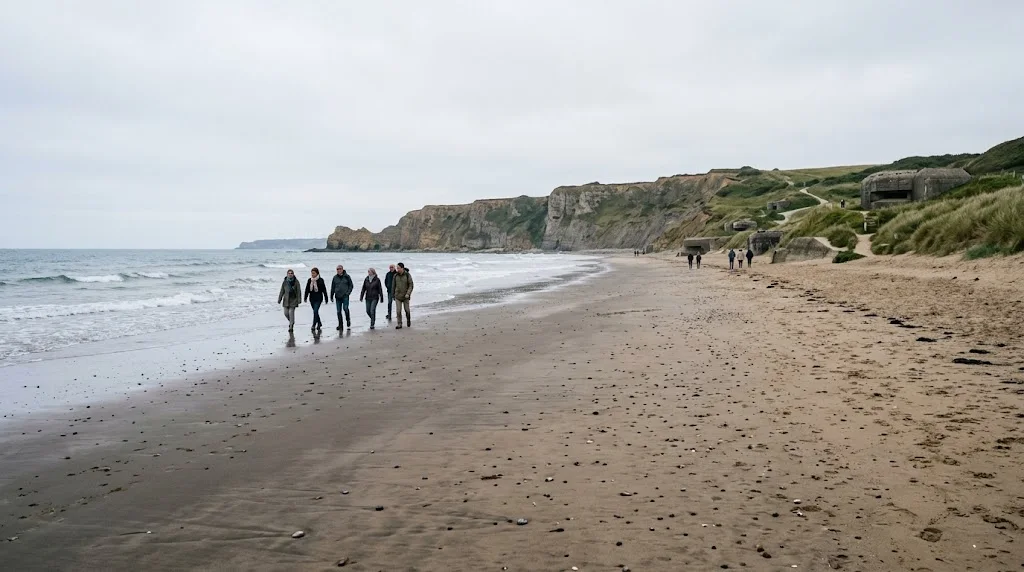
The principal D-Day landing sectors were Utah Beach, Omaha Beach, Gold Beach, Juno Beach, and Sword Beach. Pointe du Hoc is another essential battlefield site between Utah and Omaha. Together, these locations form the heart of the D-Day landing area along the Normandy coast.
Today, the region includes beaches, bunkers, museums, memorials, military cemeteries, preserved battlefield landscapes, and visitor centers. The D-Day Landing Beaches were added to the UNESCO World Heritage List in 2026, recognizing their outstanding historical and cultural significance.
15 Best Places to Visit in Normandy for D-Day
1. Omaha Beach
Best for: Understanding the American landings and visiting major memorial sites
Omaha Beach is one of the most recognizable D-Day locations in Normandy. On June 6, 1944, American forces landed here under extremely difficult conditions.
The beach itself is broad and peaceful today, which can make the historical significance of the landscape especially striking. Visitors can walk along the shoreline, explore nearby memorials, and combine the visit with several important sites around Colleville-sur-Mer and Saint-Laurent-sur-Mer.
For many visitors, Omaha Beach is the essential starting point for an American-focused D-Day itinerary.
2. Normandy American Cemetery
Best for: Remembrance, reflection, and understanding the human cost of the campaign
Located above Omaha Beach at Colleville-sur-Mer, Normandy American Cemetery is one of the most moving places to visit in the region. The cemetery overlooks the coast and contains the graves of thousands of American service members who died during the D-Day landings and the Battle of Normandy.
The carefully maintained grounds, rows of white headstones, memorial, and views toward the sea create a powerful place for reflection. Allow enough time to visit respectfully rather than treating the cemetery as a quick photo stop.
3. Pointe du Hoc
Best for: Battlefield landscapes, bunkers, and understanding the difficulty of the D-Day assault
Pointe du Hoc was a strategically important German position overlooking the English Channel. On D-Day, U.S. Army Rangers climbed the cliffs and attacked the German defenses.
The site remains particularly memorable because large shell craters, concrete fortifications, and remnants of the battlefield can still be seen. Walking through the landscape gives visitors a better sense of the physical challenges faced by the soldiers.
Pointe du Hoc is located between Utah and Omaha beaches, making it easy to combine with both areas during a driving itinerary.
4. Utah Beach
Best for: American D-Day history, museums, and combining coastal and airborne history
Utah Beach was the westernmost of the five main D-Day landing beaches. American forces landed here on June 6, 1944, and the surrounding area also played an important role in the airborne operations conducted inland.
The Utah Beach area includes a museum and memorial sites that help explain the landing operation and the experiences of the troops who came ashore.
Utah Beach is particularly useful as part of a wider itinerary that also includes Sainte-Mère-Église and the Airborne Museum.
5. Sainte-Mère-Église
Best for: Airborne history and understanding the American paratrooper operation
Sainte-Mère-Église became an important location during the airborne phase of D-Day. The town is closely associated with American paratroopers and is one of the most recognizable inland stops on a Normandy D-Day tour.
The town’s history is closely connected to the airborne operation, making it a natural companion to Utah Beach. Visitors interested in paratrooper history should allow time for the local museums and memorials.
6. Airborne Museum
Best for: Paratrooper history, military exhibits, and immersive museum experiences
The Airborne Museum in Sainte-Mère-Église focuses on the American airborne forces involved in the Normandy invasion. Exhibits help explain the preparation, equipment, aircraft, and experiences of the paratroopers.
It is one of the strongest museum choices for visitors who want to understand what happened beyond the beaches on D-Day.
7. Gold Beach
Best for: British D-Day history and the story of the central landing sector
Gold Beach was one of the three landing beaches assigned to British forces. The area around Arromanches is especially important because of the artificial harbor constructed after the landings.
Visiting Gold Beach helps put the British contribution into the broader context of the invasion. The coastline also contains remnants and memorials connected with the operation.
8. Arromanches-les-Bains
Best for: Mulberry harbor history and understanding the logistics of the invasion
Arromanches is one of the most fascinating D-Day destinations because of the remains of the artificial Mulberry harbor that can still be seen offshore.
The harbor was created to support the movement of troops, vehicles, equipment, and supplies after the initial landings. Seeing the remaining concrete structures makes it easier to understand that D-Day was not simply a beach assault but the beginning of a massive logistical operation.
9. Arromanches 360
Best for: Visual storytelling and understanding the Battle of Normandy
The Arromanches 360 circular cinema provides an immersive presentation about the D-Day landings and the Battle of Normandy.
It can be especially useful early in a trip because it provides broader historical context before you visit individual beaches and battlefield sites.
10. Juno Beach
Best for: Canadian D-Day history
Juno Beach was assigned to Canadian forces during the Normandy landings. The area is an important destination for visitors who want to understand Canada’s role in the liberation of Europe.
The Juno Beach Centre provides historical exhibitions focused on Canada’s military and civilian experience during the Second World War and the D-Day campaign.
Including Juno Beach in your itinerary helps ensure that a Normandy trip does not focus exclusively on the American experience.
11. Sword Beach
Best for: British and Commonwealth D-Day history
Sword Beach was the easternmost of the five principal D-Day landing beaches. British forces landed here, with the operation also involving French and other Allied personnel.
The area provides another perspective on the scale of the invasion and the different objectives assigned to each landing sector.
12. German Military Cemetery at La Cambe
Best for: Understanding the Battle of Normandy from another historical perspective
The German Military Cemetery at La Cambe is an important place of remembrance near the American sector.
Visiting military cemeteries on different sides of the conflict can provide a broader understanding of the human consequences of the Battle of Normandy. The site should be approached as a place of remembrance and reflection rather than simply another tourist attraction.
13. Overlord Museum
Best for: Military equipment, artifacts, and the wider Battle of Normandy
Near Omaha Beach, the Overlord Museum presents an extensive collection related to the D-Day landings and the Battle of Normandy. Exhibits include military vehicles, equipment, artifacts, and reconstructed scenes.
The museum is particularly useful for visitors who want to connect what they see on the beaches with the technology, vehicles, and people involved in the campaign.
14. Mémorial de Caen
Best for: Broader historical context before visiting the battlefields
The Mémorial de Caen is a major museum and memorial center covering the Second World War, D-Day, the Battle of Normandy, and the wider history surrounding the conflict.
It is a good first stop for travelers who want historical context before visiting the beaches. Understanding the political and military background can make the battlefield locations much more meaningful.
15. British Military Cemetery in Bayeux
Best for: Remembrance and British Commonwealth history
Bayeux is an excellent base for exploring the D-Day beaches, and its British Military Cemetery is an important place of remembrance.
The cemetery contains the graves of Commonwealth and other Allied personnel who died during the Battle of Normandy. A visit here complements the American cemetery at Colleville-sur-Mer and helps illustrate the multinational character of the campaign.
D-Day Beaches in Normandy at a Glance
| Location | Main Historical Connection | Best For |
|---|---|---|
| Utah Beach | American landings | American D-Day history |
| Omaha Beach | American landings | Battlefield history and remembrance |
| Gold Beach | British landings | British D-Day history |
| Juno Beach | Canadian landings | Canadian military history |
| Sword Beach | British and Allied landings | Eastern D-Day sector |
| Pointe du Hoc | U.S. Army Rangers | Battlefield landscape and bunkers |
How Many Days Do You Need for the Normandy D-Day Sites?
A two-day D-Day itinerary can cover many of the most important locations, while three or four days allows you to explore the region at a more relaxed pace.
One Day
If you only have one day, focus on one geographic area rather than trying to visit every beach. A practical American-focused route could include Omaha Beach, Normandy American Cemetery, Pointe du Hoc, and a nearby museum.
Two Days
With two days, you can divide the trip between the American sector and the central/eastern landing beaches. For example, spend one day around Utah Beach and Sainte-Mère-Église and another around Omaha Beach, Pointe du Hoc, and Arromanches.
Three to Four Days
A longer trip gives you time to explore Utah, Omaha, Gold, Juno, and Sword, while also visiting museums, cemeteries, and inland battlefield locations.
Normandy Tourism also provides a four-day itinerary option for travelers who want to explore the landing beaches in greater depth.
Where Is the Best Place to Stay for a D-Day Tour?
Bayeux is one of the most practical bases for a Normandy D-Day trip. Its location makes it convenient for reaching several major sites, and the town offers accommodation, restaurants, museums, and transportation connections.
Caen can also work well, particularly for travelers arriving by train or combining D-Day history with a broader Normandy trip.
For a more immersive coastal experience, consider staying closer to the landing beaches, although smaller towns may have fewer accommodation choices than Bayeux or Caen.
How to Visit Normandy D-Day Sites Without a Car
A car provides the greatest flexibility because D-Day sites are spread across a large area. However, a car is not absolutely necessary for every itinerary.
Normandy Tourism identifies Caen, Bayeux, and Carentan as useful rail access points for exploring the D-Day area. Some museums and sites can also be reached using regional public transportation, although schedules can be limited and seasonal.
If you do not have a car, check transportation schedules carefully and consider joining a guided tour from a larger town. A guided tour can also help explain the historical significance of sites that may otherwise look like ordinary countryside or beaches.
Best Time to Visit the Normandy D-Day Beaches
The D-Day beaches can be visited throughout the year. Early June is the busiest and most eventful period because commemorations take place around June 6.
If you want to experience anniversary events and ceremonies, plan well ahead because accommodation and tours can become highly sought after. If you prefer quieter conditions, spring, autumn, or winter can provide a more peaceful experience.
Weather and opening hours vary throughout the year, so check individual museums and attractions before traveling.
Tips for Visiting the D-Day Sites in Normandy
- Learn the basic history first. Even a short introduction to Operation Overlord will make the sites easier to understand.
- Do not rush the cemeteries. Allow time for reflection and respect the purpose of these locations.
- Group nearby sites together. Normandy’s D-Day attractions are spread across a large area.
- Wear comfortable shoes. You may walk across beaches, grass, uneven ground, and historic battlefield areas.
- Check tide conditions. The appearance and accessibility of coastal areas can change significantly with the tide.
- Book popular tours and accommodation early. This is especially important around the June 6 anniversary period.
- Allow more time than expected. Museums and cemeteries can be more emotionally and historically demanding than their size suggests.
- Visit more than one Allied sector. Doing so gives you a better understanding of the multinational nature of D-Day.
Are the Normandy D-Day Beaches Worth Visiting?
Yes. The Normandy D-Day beaches are worth visiting for anyone interested in military history, World War II, European history, remembrance, or the human stories behind major historical events.
What makes Normandy different from a conventional historical attraction is that the landscape itself is part of the story. The beaches, cliffs, villages, bunkers, cemeteries, and fields remain connected to events that happened there in 1944.
The experience is most meaningful when approached as a journey of remembrance rather than simply a sightseeing checklist.
Frequently Asked Questions
What is the best D-Day site to visit in Normandy?
Omaha Beach and the Normandy American Cemetery are among the most important stops for first-time visitors, while Pointe du Hoc, Utah Beach, Arromanches, and Sainte-Mère-Église add important perspectives on the wider operation.
Which D-Day beaches should I visit?
If you have enough time, visit all five main landing sectors: Utah, Omaha, Gold, Juno, and Sword. If your time is limited, prioritize the beaches and museums that match your historical interests.
How far are the D-Day beaches from Paris?
The Normandy D-Day area is several hours from Paris by road, depending on the exact destination and traffic. Bayeux and Caen are commonly used as bases for exploring the landing beaches.
Can you visit Normandy D-Day sites in one day?
Yes, but a one-day trip requires careful planning. Focus on one sector rather than attempting to cover every beach. A guided tour can help maximize your time.
What is the most famous D-Day beach?
Omaha Beach is arguably the most famous of the Normandy landing beaches, particularly because of the intense fighting experienced by American forces there. However, each landing sector played a distinct role in the overall invasion.
Is Normandy good for a history trip?
Normandy is an exceptional destination for a history-focused trip. Beyond D-Day, the region contains museums, medieval heritage, historic towns, military cemeteries, and sites connected with the broader Battle of Normandy.
Final Thoughts
The best places to visit in Normandy for D-Day are not limited to the beaches themselves. Omaha Beach, Utah Beach, Pointe du Hoc, Normandy American Cemetery, Sainte-Mère-Église, Arromanches, Juno Beach, Sword Beach, museums, and military cemeteries each reveal a different part of the story.
For a first visit, build your itinerary around a few major sites rather than trying to see everything. Give yourself enough time to understand what happened at each location, and approach the cemeteries and memorials with the respect they deserve.
Normandy’s D-Day landscape remains a powerful reminder of the scale of the 1944 invasion, the international forces involved, and the enormous human cost of the campaign. Visiting these places is ultimately about more than history—it is an opportunity to remember the people behind it.